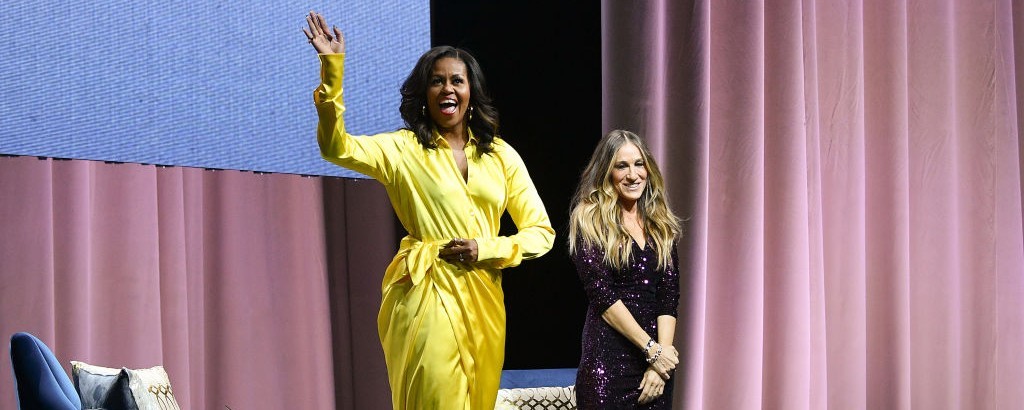
It was December 2018, the final stop of Michelle Obama's Becoming book tour, a conversation with style icon and actor Sarah Jessica Parker. The internet lost its mind about the boots. What most of the internet missed was more impactful and more instructive. Obama's body arrived on stage before her words did, at exactly the pace she chose. She didn't shrink a millimeter to make anyone else more comfortable with the sight of her.
Go watch it. Two minutes. The walk-on is the whole lesson: Sarah Jessica Parker welcomes Michelle Obama to the stage.
That is executive presence.
What it really means
Executive presence is the absence of apologizing with your body, so you don’t lose the audience before you even open your mouth.
And you can learn how to convey it everywhere you go.
The problem with how we teach executive presence
Most executive presence coaching sounds like emotional advice dressed up as leadership training. Own your power. Speak with authority. Believe in your voice. Feel your gravitas.
I have never once seen someone become more executive by trying to feel more executive.
The advice fails the people who need it most — often the most accomplished women in senior roles who are told they need "more presence" without anyone defining what that really means. They already have confidence. They have the credentials, the track record, the results. What they're being asked to change is not internal. It's external and physical. And no one is teaching them that part.
The reframe
Executive presence is a set of observable behaviors your body exhibits on stage, in a meeting room, in the spotlight. It works whether you feel it or not. That's the whole point. If you have to feel executive to look executive, you don't actually have executive presence. You have good moods.
The behaviors below are the ones I coach senior physicians and executives on before a keynote, a panel, a webinar, a board presentation. Ten of them. Every one is trainable. Every one is visible. None of them require you to feel anything first.
The 10 behaviors
1. Walk the first five steps before you speak.
You're at the mark before you do anything. Body weight settled. You look at the audience for one full beat. Then, the first word comes out. No talking while still walking. This is the single easiest behavior to install, and it changes how a room receives you without you saying a word.
2. Plant your feet hip-width. Don't shift.
Both feet flat. Weight evenly spread. No swaying, no rocking. If you need to move, take three deliberate steps and re-plant. The audience reads a still body as a certain one, whether you feel certain or not.
3. Drop your opening rate of speaking.
Speak the first 30 seconds intentionally slower than your normal cadence. One thought, pause, next thought. The audience should feel you're in no rush to earn their attention. Rushing looks like trying too hard.
4. Use a two-beat pause after your hook.
Deliver the opening line. Silently count one, two while making eye contact with one person. Then continue. The pause feels too long to you, but exactly right to the room. Executive presence lives in the pauses.
5. Lower your last word.
End declarative sentences on a down pitch. Not an up-tilt. Statements of authority should sound like statements, not questions. "This is what changed everything" ends on everything, and the pitch drops. Up-tilt is reserved for actual questions.
6. Name the elephant first, briefly, then move on.
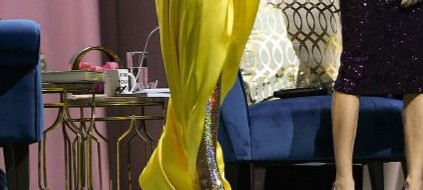
If something is visibly unusual — the outfit, the topic, the audience size, acknowledge it in one short sentence with zero apology. Then pivot. Yes, the boots. Let's talk about the work. You don't explain, and you don't joke nervously. Naming it once removes its power. Apologizing for it hands the room your authority.
Watch Michelle Obama do exactly this with the boots — one acknowledgment, no explanation, straight back to the work.
7. Look at one person, finish a sentence, then move.
Pick a face. Deliver a complete thought to them. Then move your eyes to a different face for the next thought. No scan-sweeping. No delivering to the ceiling. Audiences of a thousand or more should still be reached as individuals, one at a time.
8. Take up your full wingspan when you gesture.
Gestures break the plane of your shoulders. Arms should move out from the body, not stay pinned to your ribs. When you're not gesturing, hands rest open at your sides. Not clasped. Not in pockets. Diminished bodies read as diminished authority. It doesn't matter how tall you are, take up space.
9. Refuse the rushed answer in Q&A.
When you’re asked a question, pause for two full beats before the first word. Even if you know the answer. You may want to repeat the question back slowly. Then, answer in two or three sentences and stop. The pause is the presence. Rushing to answer is the second-strongest apology your body can make on stage.
10. Exit at the same speed you entered.
After the final line, hold the spot for one beat. Half-nod. Walk off at the same unhurried pace you walked on with. No scurry. No trailing thank you so much over your shoulder. The exit is a bookend. When the entrance said this room belongs to me, the exit needs to match.
The Michelle Obama test
Before you walk on stage for anything, ask yourself one question.
Would I do this exact thing in sparkling, thigh-high Balenciaga boots?
If the answer is no, I'd shrink a little, that is the behavior to fix. Of course, it’s not really about the boots — they stand in for anything the room might notice or expect you to apologize for. Your age. Your accent. Your gender. The fact that you got the promotion someone else was expecting. The fact that you are exactly the right person for this job and everyone in the room already knows it.
You don't have to feel executive to appear executive. Anyone can walk the five steps, plant their feet, lower the last word, hold the exit. These behaviors work independent of how you feel, which means you can practice them this week, on your next call, before your next talk, regardless of whether you slept well the night before or feel a whisper of impostor syndrome.
Executive presence is the physical, external manifestation of a decision to stop shrinking. Pick one behavior. Try it on your next stage moment. Tell me what happened.
If this is the kind of thinking that lands for you …
… you'll like Field Notes.
It's my monthly letter to a small inner circle of senior professionals who are thinking hard about what a full career actually asks of them — and making brave choices to live a more meaningful professional life. It’s a different register than what I publish here. More candid. Peer-to-peer.
Sign up, and I'll send you my What Matters Most to You Workbook when you do. Use it to take the first step in creating a professional life that enables more of what you love.
Image credit: Getty Images.
Image description: Michelle Obama walking onto the Barclays Center stage in yellow-and-gold Balenciaga, wearing thigh-high, sparkling boots peeking out from a boldly colored dress and waving to the crowd. She is standing next to Sarah Jessica Parker, who wears a dark, sparkling dress and high heels.

.webp)