
Once again, I had the privilege of attending the Winter Session of the Executive Leadership in Academic Medicine program hosted by Drexel University in cold and snowy Philadelphia at the end of January. I participated in this leadership development program as a fellow in 2007-2008 and have more recently been the program’s lead coach for many years.
I love getting the chance to meet and work with the amazing leaders who participate in the ELAM (for leaders in academic medicine) and ELH (Executive Leadership in Health Care, for operational leaders in health systems) components of the program. I also appreciate having the opportunity to learn from speakers who are at the cutting edge of leadership skill development.The experience never fails to teach and inspire me. I always enjoy sharing these experiences with this community. Here’s what I brought home from ELAM Winter 2026:
Grace, gratitude and trust are hallmarks of the ELAM experience
During the opening session, Executive Director Dr. Nancy Spector reminded everyone that ELAM sessions are most meaningful when we practice grace and gratitude, and when we allow ourselves to both stretch and trust the process.
What did she mean? Well, in a group of 150-plus high-functioning, high-achieving professionals, it would be easy for egos to be in the lead and for competition to rule the day. Fortunately, that’s not how ELAM works.
Having the grace to stand in our own accomplishments,celebrate everyone’s achievements, and learn from and with each other is a hallmark of the ELAM community. It’s amazing to watch, and it’s inspiring. It’s also something for which I am grateful. We open each week-long session by offering gratitude to everyone (friends, family, colleagues) who gave up something to help each of us take the time and space to learn and grow together. Being at ELAM is a stretch, or a period of intentional growth, for all of us.
Particularly for those who are new to the community, learning to trust the yearlong ELAM process is an exercise in understanding and patience. The ELAM program is rooted in more than 30 years of experience, and like the participants, program leaders are always learning, improving, refining. There is a proven arc of learning baked into the experience, even if participants can’t always see in the moment where it will lead. To me, Dr. Spector’s message really encapsulates what it means to be a part of this community.
.jpg)
My remaining pearls are really self-explanatory quotes from several of the speakers — things that stuck with me and that I continue to turn over in my mind as I head home from this awesome week among friends and colleagues.
Using time and energy with intention is good for us — and those we lead
I learn something every time I hear business leader and consultant Leo Hopf speak. This quote, in particular, sticks with me: “We must learn to say ‘no’ with a period after it so that we can say ‘yes!’ with an exclamation point.” He is so right, and his messages to the ELAM community about delegation, organizational thinking and high-value work were spot-on. I highly recommend Leo’s two books, Stop Competing and Start Winning (with Beth Launiere) and Rethink, Reinvent, Reposition: 12 Strategies to Renew Your Business and Boost Your Bottom Line (with William Welter).
Negotiation is an investment in you
We had a tremendous set of presentations about negotiation strategies. Dr.Valerie Purdie-Greenaway’s talk, The Science of Negotiating for Leadership Success, included this message: “Career negotiations are career-related conversations and requests that involve problem solving, creative options, tradeoffs, or conflicts to be resolved with colleagues or family and friends.“ (Thompson, 2005; Riley Bowles, 2019)
This message aligns so well with the way I see careers and career strategy: It really is problem-solving in the context of our entire lives. It was a privilege to hear from this accomplished social scientist. Check out her work at the Columbia University Laboratory for Intergroup Relations and the Social Mind. She is, frankly, amazing!
Sara Laschever, a well-known scholar and author about negotiation, particularly for women, also shared meaningful insights. Among them: “If you never hear ‘no,’ you are not asking for enough (or often enough) in your negotiations.”
Wow! This made me stop and think. She speaks to the importance of asking for your real value from the earliest stages of your career. Check out her well-known books, Women Don’t Ask: Negotiating and the Gender Divide and Ask For It: How Women Can Use the Power of Negotiation to Get What They Really Want (both books co-authored with Linda Babcock).
Use your voice (when you have something to say) for impact
Perhaps the most important takeaway for me — because it makes me stop and think about everything I say and many things I do — came from my colleague Joyce Collins, who did an amazing presentation on Optimizing Your LinkedIn. She taught us about the WAIT method to filter what we put on social media. WAIT is an acronym for the question we must always ask: “Why Am I Talking?”
Why WAIT? In a nutshell: If we don’t have a really good reason for saying or posting something on social media, we should probably step away from the keyboard. This reminds me of the old saying often attributed to Rumi, “Before you speak, let your words pass through three gates: Is it true? Is it necessary? Is it kind?” These are helpful filters for any conversation to which we think we have something to contribute.
Four-Way Wins — and the magic of learning community connections
Finally, I had the privilege of moderating four learning community groups (LCs 13, 14, 15 and 16) as they presented their Four-Way Wins. This concept asks fellows to find an activity that provides them a “win” at home, at work, in their community and for their own self-care. This concept comes from a wonderful book by Stewart Friedman, Total Leadership: Be a Better Leader, Have a Richer Life, and it is helpful for creating work-life alignment and normalizing attention to more than achieving results at work.
Some of what will stick with me after watching these presentations:
- The unexplainable (by me) connection between haikus and the movie “The Princess Bride”
- Cynicism is cheap
- The “joy patrol challenge,” asks all of us to be on “patrol” to help find joy
- Joy can be a political statement — find where your great joy meets the world’s great need
- Treat yourself (see the photo below — I got my sticker and wore it proudly)
- Many journeys meet in shared horizons
- A poignant moment when we closed the evening grounding ourselves with Mountain Pose as part of a yoga demonstration
My ELAM 2008 classmate and learning community member (shout-out to the Delta Divas!) Dr. Archana Chaterjee leads this part of the curriculum, and she introduced many of us to Stewart Friedman’s book. I had the great pleasure of seeing Archie during our group’s presentations, and she gave me permission to share the photo below of the two of us — we sure look different than in 2008!
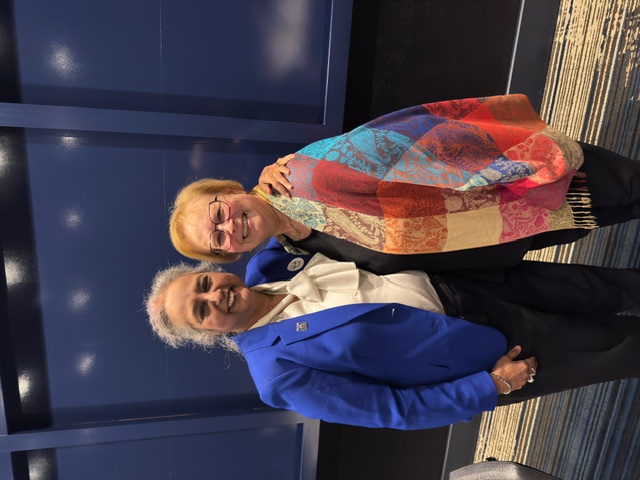
Thanks, Archie, for all the good you do for the world. It’s my privilege to know you.
And it’s my privilege to be part of the ELAM community. I can’t wait for the Spring Session.